Reproduced with permission of Breeding News for Sport Horses
www.breedingnews.com

Why start from scratch when the breeding blueprint already exists?
Apr 28, 2026
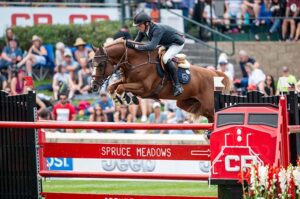
After winning the $3 million CP International Grand Prix in 2019 with Beezie Madden, Darry-Lou was sold to Jennifer Gates' Evergate Stables, returning to Spruce Meadows the following year with her husband Nayel Nassar to win the CSIO5* CANA Cup. The stallion then passed to Harrie Smolders (photo above), shining again with a top-10 finish in the 2022 Rolex Grand Prix at Spruce Meadows, before retiring to stud at Zangersheide.
BY ED BALCEWICH
PHOTOS: JUMP MEDIA; CHLOE MELNYCHUK/CB MEDIA; WORLD OF SHOWJUMPING
The cover of our June 2021 issue, #294, featured a beautiful image of a Selle Français mare with her miracle blue-blooded twin foals, born in rural Manitoba, Canada. Their birth was the result of a decision made at that time by breeding partners Ed Balcewich and Jeff From. Ed now picks up the story, to date.
At the 2019 Spruce Meadows Masters, the International Ring was doing what it does better than almost anywhere in the world: putting horses and riders under real pressure. We had front-row seats for the $3 million CP International Grand Prix, close enough to feel the atmosphere tighten with every clear round and close enough to watch the best in the world answer the kind of questions only Spruce Meadows can ask. Then Beezie Madden and Darry Lou came into the ring. Their victory was impressive, but what truly stood out was Darry Lou's jump. He was quick off the floor, exceptionally careful, sharp in his reflexes, and always in balance. Under Beezie, he looked like a complete jumper: blood, scope, carefulness, responsiveness, and control all working together in one horse. For most breeders, a performance like that raises a familiar question: how do you breed another one?
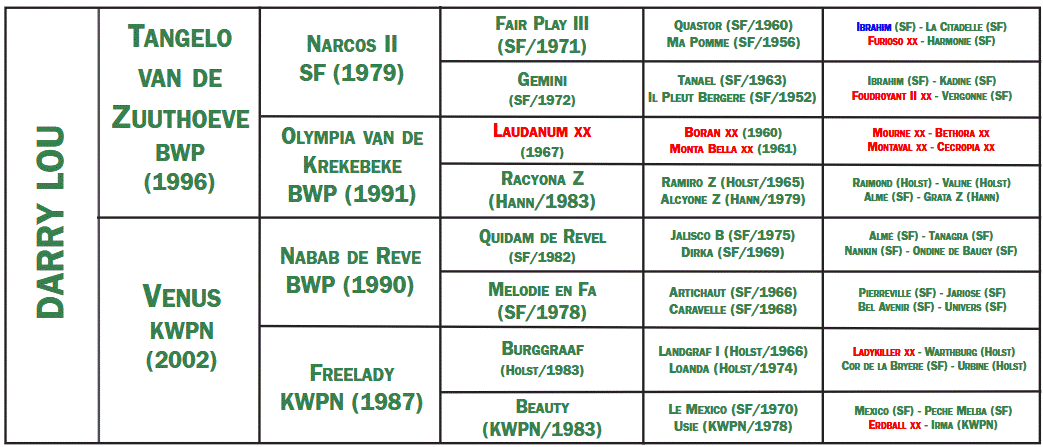
That afternoon, though, my attention shifted away from the result and toward the structure behind it. Horses like Darry Lou do not come from nowhere. They come from pedigrees that have already shown an ability to combine the qualities the sport demands. When I went back through his pedigree, what struck me was not only how modern it was, but how familiar parts of it felt.
At Desiderius Farms in St. Andrews, Manitoba, where I breed horses with Jeff From and Nehal Jora, some of our mares carried remarkably similar architecture. Years later, that question would come back into sharper focus through Halo DF, one of the SF miracle twins born in our own program. That was the starting point for what we eventually began calling Framework Linebreeding.
It was not a grand theory at first. It was simply an observation: if certain bloodlines have already shown that they can consistently produce the type of horse breeders value, it may make more sense to stay close to those structures than to start from zero each time.
Across 12 Generations
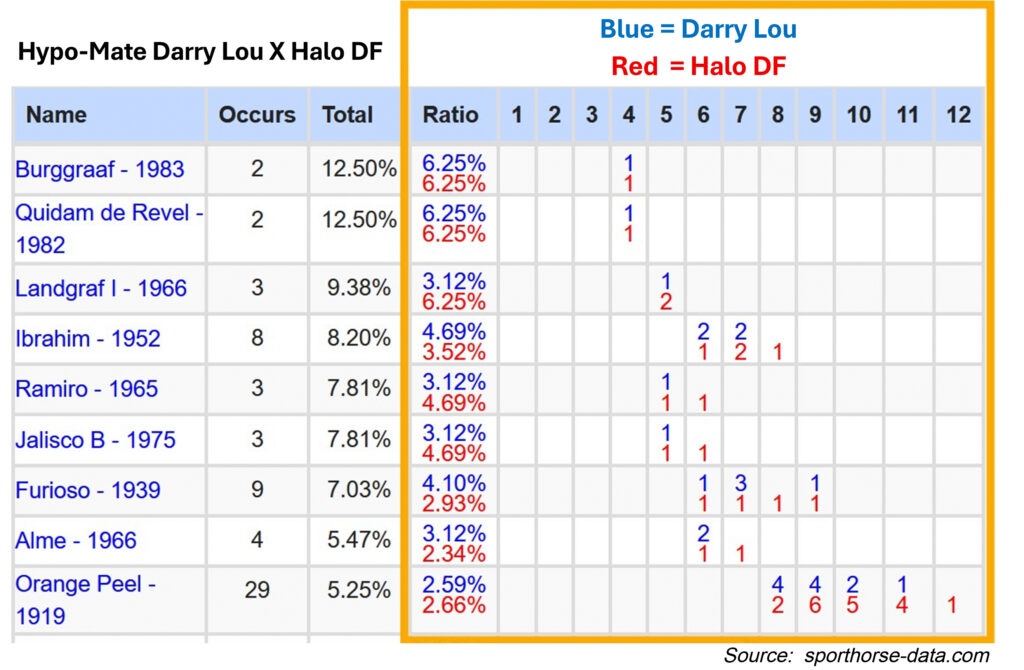
Darry Lou and Halo DF share many of the same ancestors in many of the same generational positions, making the similarity in their underlying framework easy to see.
The Gretzky lesson
To explain variance, I often reach for hockey. That is partly because I live in Canada, where hockey is woven into the culture, and partly because Wayne Gretzky offers such a clear example. For readers outside North America, Gretzky is the undisputed GOAT – the Greatest of All Time – in hockey.
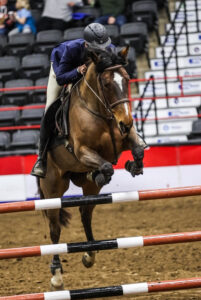
Halo DF (Grama Open Main - Zena QV x Quite Easy)
He retired in 1999, and many of his records still stand. One of them, shared with his brother Brent, is especially useful here. Together, they hold the NHL record for the most combined points by two brothers: 2,861. Wayne scored 2,857 of them. Brent scored four!
That distinction matters. The six Sutter brothers scored 77 more points as a family, but they needed more than 3,500 additional NHL games to do it. Among two brothers, the Gretzkys remain the record-holders, and the imbalance between them is what makes the example so relevant.
This is not to diminish Brent Gretzky. Reaching the NHL at all is an extraordinary achievement. The point is that even within the same family, with many of the same underlying ingredients, the expression of elite ability can vary enormously. One brother became the greatest player the sport has known. The other, by any normal standard a highly accomplished athlete, had a completely different career.
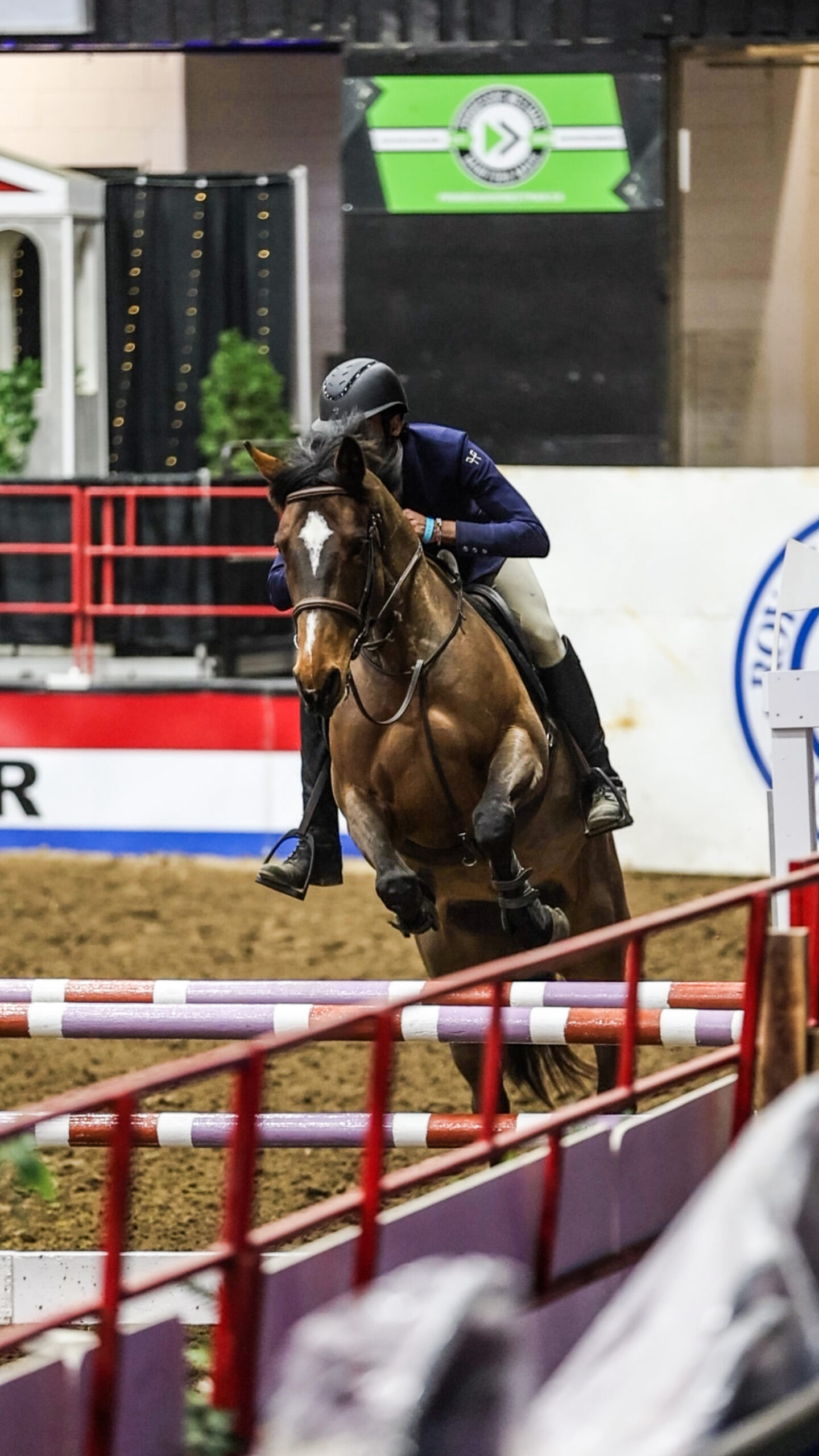
Halo DF (Grama Open Main - Zena QV x Quite Easy)
For European readers, football offers the same lesson. Even shared blood and environment do not reproduce Messi's or Ronaldo's level of ability in their siblings. Breeders know this principle well. Similar origins do not guarantee similar outcomes. Genetics does not distribute excellence evenly, even in strong families. That naturally raises another question. If even the parents of a Gretzky, Messi, or Ronaldo do not produce multiple GOATs from the same gene pool, why would a breeder stay close to a proven gene pool and hope for a comparable result?
The answer is that the goal is not to expect the blood to repeat greatness automatically. The goal is to improve the probability within that blood by how it is arranged. Human families are not deliberately linebred. Breeders, however, can work with structure. They can reinforce certain influences, preserve balance, concentrate traits through both male and female lines, and make more intentional use of a proven population of blood. That is where Framework Linebreeding begins. Not with the fantasy of reproducing a GOAT on demand, but with the practical belief that within the right gene pool, structure matters. If variance cannot be eliminated, then the intelligent move is to shape the odds as carefully as possible.
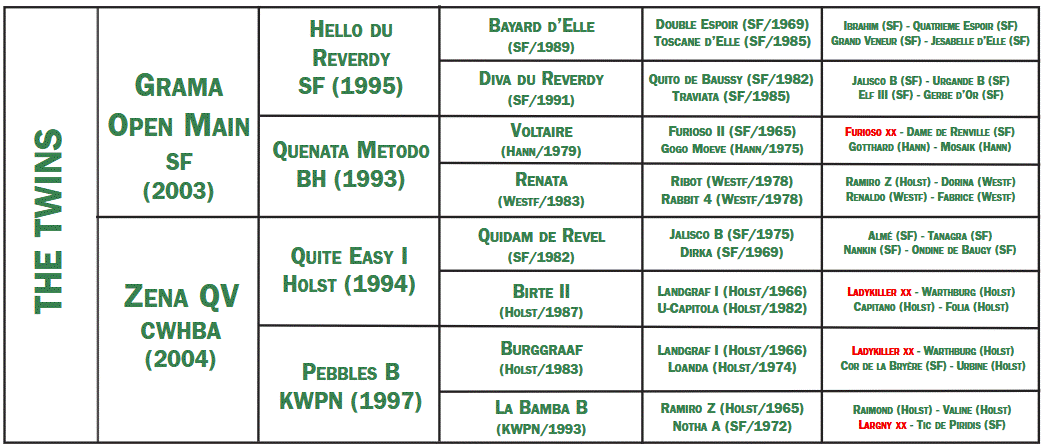
How the architecture revealed itself
Framework Linebreeding did not come from the resources of a large European operation. It came from a smaller reality. We are small breeders in Canada. Our herd has to remain manageable – roughly 15 to 20 horses, not 200. That changes the economics and the decision-making. When numbers are limited, every mating matters more. You cannot breed broadly, test endless combinations, and let volume sort out the results. You need to think carefully about where your best odds are.
Then came Covid
Like so many people, we suddenly had more time than usual. During those long lockdown months we did what small breeders with curiosity and access to strong pedigree tools can do: we studied bloodlines in depth. We looked at stallions, mares, families, recurring crosses, top jumpers, older influences, and patterns that seemed to appear more than once. We also benefited from many discussions with Kathleen H. Kirsan and ran hundreds of hypothetical matings through pedigree subscriptions, testing ideas around potency, pedigree structure, and gender balance.
Over time, what began as curiosity became a way of seeing. The more pedigrees we studied, the less random jumping bloodlines appeared. Certain names came back repeatedly, but more importantly, certain structures did. The pedigrees were not identical, but they often rhymed. That mattered to us. Not because we believed we had found something the world's best breeders had missed, but because it gave us a framework that made practical sense for a program of our size. If you cannot treat every season like a fresh lottery ticket, you need a way of identifying where elite qualities have already shown an ability to exist together and then making disciplined decisions within that territory.
That is what we mean by architecture. Not fashion or superficial stacking of famous names, but the deeper structural logic of a pedigree: the recurring framework that continues to appear in the modern jumper because it has repeatedly transmitted something valuable.
And that framework is not built only through the obvious male lines. The female side matters as well. We found it important to follow daughters as carefully as sons, to pay attention to gender balance, and to respect what mare families continue to carry forward. The dam lines are not background detail. They are part of the structure itself.
The pedigree thinkers
None of this thinking developed in isolation. The deeper we went into pedigrees, the more obvious it became that serious breeders have always looked for patterns beneath the surface. Long before digital databases made this kind of study easier, thoughtful horsemen were already paying attention to families, transmission, recurrence, and the fact that some lines consistently carried more than others.
Federico Tesio remains the obvious reference point. Not because he left behind a formula that can simply be copied, but because he approached breeding as both art and disciplined inquiry. He believed that inheritance had structure, that potency mattered, and that a breeder's job was not merely to admire an individual horse, but to understand what stood behind it and what it might pass on.
That same seriousness can be found, in different ways, in the work of Harold Hampton, Clive Harper, Jac Remijnse, and Kathleen H. Kirsan. Their language may differ, but all treated pedigree as more than ornament. They read it as evidence. They looked not just for performance, but for transmission; not just for a good horse, but for the deeper family logic that made good horses more likely to appear again. In that sense, Framework Linebreeding is not a rejection of traditional breeding wisdom. If anything, it is an attempt to listen more carefully to it.
Modern breeding can sometimes become too focused on the immediate present: the latest winner, the fashionable sire, the current commercial trend. Pedigree asks a longer question. It asks not only what a horse is, but what stands behind it, and what is likely to endure.
The horse still has to be good!
For all the emphasis on structure, one point remains simple: the horse standing in front of you still has to be good. Paper does not jump a fence. A famous name in the third generation does not create reflexes, courage, soundness, or technique where they do not exist. Pedigree can guide a breeder, sharpen a program, and explain why certain qualities may be present, but it cannot rescue a weak individual.
At the same time, breeding history is full of horses that remind us the eye alone is not enough. Some exceptional performers were not obvious beauties. Some influential producers were not horses that would have attracted universal admiration standing in the aisle. Beauty and function do not always travel together, and an ordinary-looking individual can sometimes carry unusual transmitting power.
That is where pedigree becomes especially useful – not as an excuse, but as a lens. It can help explain why a horse that seems ordinary in one respect may still belong to an extraordinary family structure, and why a horse with less immediate glamour may still deserve serious consideration because of what stands behind it and what it may pass on. For us, the balance is straightforward: the horse must be good enough in its own right to justify the decision. Once that threshold is met, the pedigree matters enormously. The best breeding decisions happen when the horse and the paper are speaking the same language.
Halo DF (Grama Open Main - Zena QV x Quite Easy)
Halo DF: from miracle twin to modern prospect
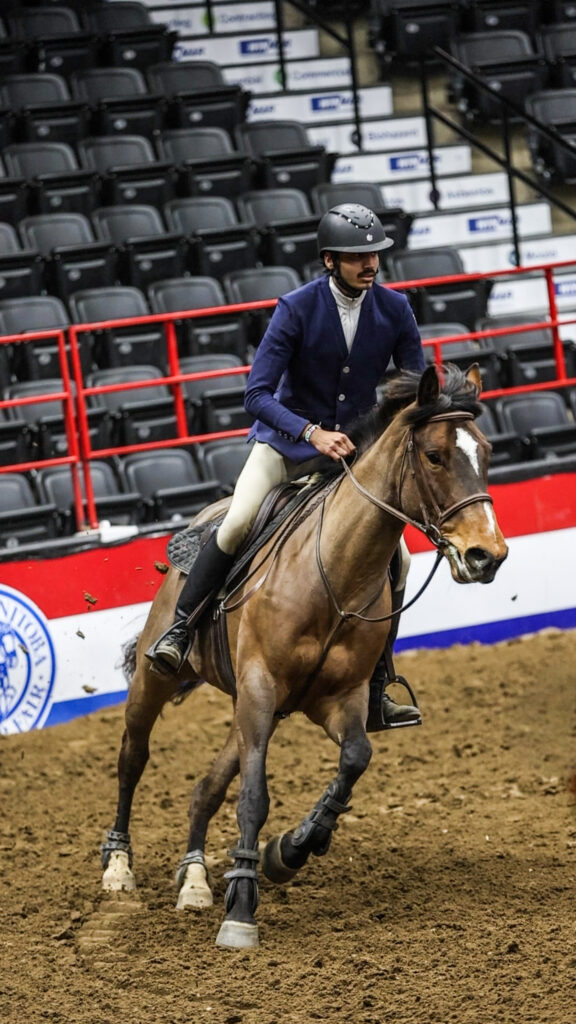
For us, Halo DF is where this discussion stopped being theoretical. Previously introduced to readers as one of the SF miracle twins, she has since become much more than a remarkable foundation story. As she has developed, she has continued to show the sort of qualities that make a breeder pay attention. Halo has also backed up the pedigree discussion with the kind of early ring record that matters.
In her maiden season at four, she was Provincial Champion at her opening height of 0m75, won the 0m85 Mini Prix, and then moved up to 0m90 with double-clear rounds and repeated top-three finishes. She ended that season by trying 1m00 and won with a double clear. After a winter of training, she began her second season in 2026 by going 100% clear in every round at her first two shows. At her third show, the Winter Fair, she moved up to 1m10, went double clear, and finished with a high placing.
She loves to compete.
At home she is exceptionally kind – an in-your-pocket horse with a warm personality. In the ring, though, she becomes our Spice Queen. She is quick across the ground, naturally careful, and able to turn and burn in a jump-off. What stands out most is the way she uses herself. She has a tight, reactive front end, and behind she finishes the jump with the kind of power top horses seem to have in reserve. If the front legs clear the fence, the back end always follows. At four years old, she surprised us with a 1m70 free jump, the kind of moment that makes a breeder stop and ask what may really be there.
None of this proves anything yet. She is still a young horse, still developing, and still writing her own story. But she is a reminder that pedigree questions are never just academic. They come alive in real horses, in real movement, and in the competitive instinct that often separates a merely talented horse from one that truly wants to do the job.
Staying where the formula works
This brings us back to Darry Lou. The point is not to copy him. The point is to understand the framework that produced him. If a horse like that represents a proven arrangement of elite qualities – if he stands as evidence that a particular structure can produce a jumper of the highest order – then breeders have two broad options. They can continue stepping outside that framework, making new combinations and hoping excellence reappears by chance. Or they can remain within the broader structure that has already shown an ability to produce that kind of horse. That, for us, is the logic of Framework Linebreeding.
It is simply the conclusion we arrived at after studying the blood as deeply as we could, within the limits of a small Canadian program that could not afford to breed without intention.
When certain frameworks have already demonstrated an ability to combine the qualities the sport demands – blood, reflexes, carefulness, scope, intelligence, and competitiveness – it seems sensible to remain close to them. Not because that guarantees greatness, but because it respects the evidence already written into the breed.
In a breeding world often drawn toward novelty, fashion, and the temptation to reinvent the wheel, there is value in staying close to what has already proven functional. Perhaps the smartest question is not, What new cross can I invent? It may be, why would I leave a framework that is already producing the modern jumper?
Further reading: Background on the bloodline frameworks behind Palloubet d'Halong, Contender and Almé Z: