Grama Open Main: A Framework Stallion for the Thinking Breeder
A deep pedigree analysis — for the breeder who already knows the real answers sit past generation four.
July 23, 2026
BY ED BALCEWICH
Grama Open Main (GOM) is not the latest headline — he’s a deliberate reassembly of the genetic structures that already built the modern sport horse.
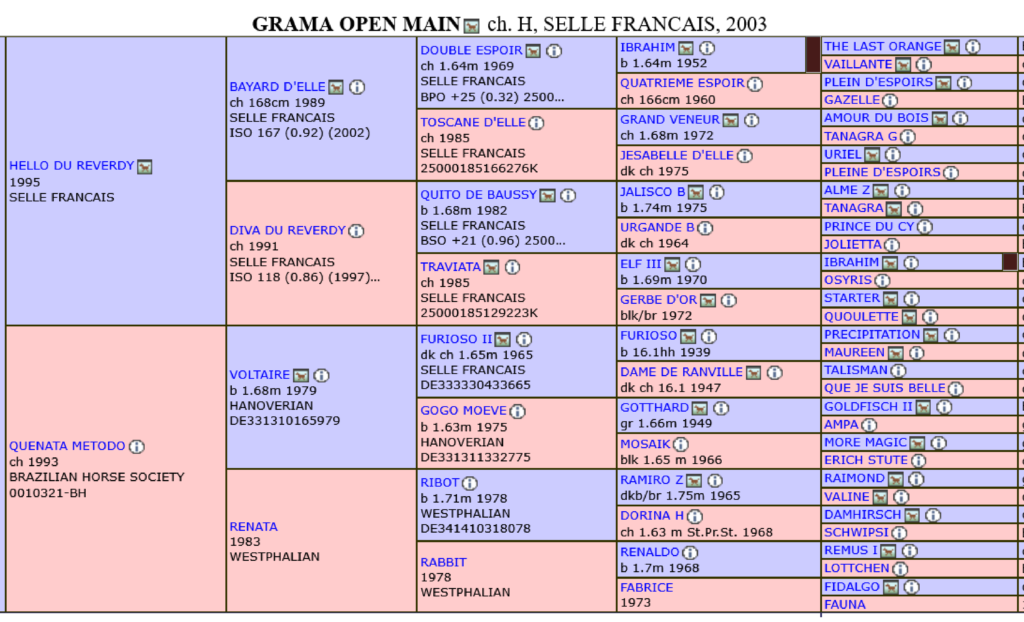
Sire Side: The Almé Z Rebuilding Machine
GOM carries Almé Z himself, not merely his relatives. Alongside him sit Double Espoir (his half-brother) and Elf III (his ¾ brother) — both proven sires in their own right — reinforced by Jalisco B and his son Quito de Baussy.
Behind Double Espoir is Bayard d’Elle, and the connection runs deeper than it looks: the d’Elle and d’Espoirs names are the same family, Family 74, bred by Alexis Pignolet at Haras d’Elle in Normandy — a farm with a real track record, producing top international jumpers like Flipper d’Elle. Bayard d’Elle carries Family 74 on both sides at once, through his sire and his dam, both routes reconnecting to the same Ibrahim foundation the whole sire side is built on.
Dam Side: The Engine Room
As the Warmblood geneticist Jac Remijnse has observed, successful showjumpers often carry relatively obscure names in their first few generations — precisely because those horses act as conduits for more important blood further back. GOM’s dam line is a clear example.
Start at the top of that dam line: Voltaire, GOM’s dam’s sire and 25% of his blood — one of the most influential jumping sires in modern breeding, with over 2,700 registered offspring and sire of international stars Kannan and Concorde. Voltaire is himself a Furioso II × Gotthard cross — meaning the same architecture behind the Stakkato Handshake below is already at work here, one generation closer to GOM.
Beneath him, the tail dam line runs unbroken through Renata, out of Rabbit, out of Fabrice, by the Thoroughbred Fidalgo out of the Westphalian mare Fauna. In GOM’s fourth generation, Renata’s sire Ribot was produced by the Holsteiner Ramiro Z — one of the most influential jumping sires of the modern era, and sire of Olympic gold medalist Ratina Z — out of the mare Dorina H.
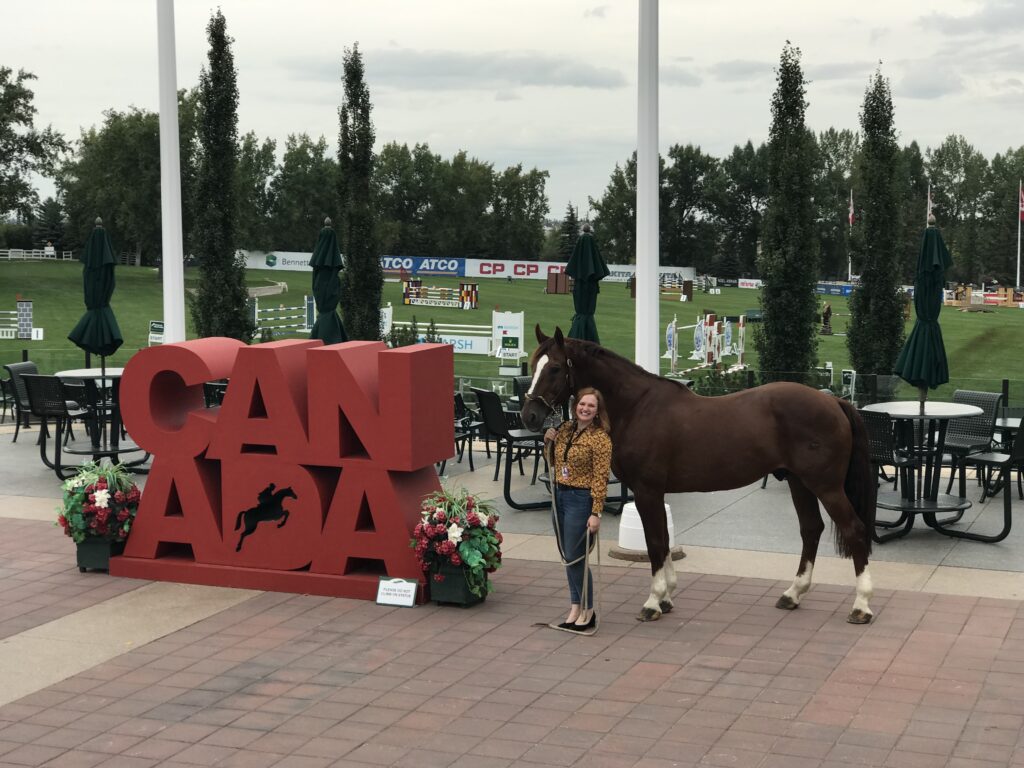
Grama Open Main at 2019 Spruce Meadows Masters
Two Branches, One Architecture
Fauna and Dorina H sit on genuinely separate branches of GOM’s pedigree, yet both independently converge on the same Hanoverian foundation. German breeders name entire sire families after their founding stallion’s first letter — so every descendant of Alderman I carries an “A,” every descendant of Fling an “F,” and so on, making a proven line traceable at a glance for generations. GOM carries several of these founding lines doubled up across both branches: the A-line (Alderman I, Adeptus), the F-line (Fling, Flingarth), and the Sport line (Sportland, Sportanzeiger II) — the same sire line behind Stakkato’s own prepotency. This is not one line counted twice. It is a small pool of proven German sires that this pedigree keeps returning to from multiple independent directions.
Positioned to Transmit
Fauna sits on GOM’s unbroken tail-female line, so her mitochondrial DNA reaches him directly, and X-chromosome material from this line can pass through him to his daughters. Her maternal family carries real credentials to match: Domane was a Hauptstutbuch mare — the highest ordinary registration tier in the German studbooks. From that level, a mare can then be tested for the higher State Premium (Staatsprämie) title. Domane is backed by two consecutive generations of State Premium dams: her own dam, Delia, and Domane’s two grandmothers, Faschingsgirl and Sardine.
The Pocahontas Concentration
Fidalgo, standing at the head of that same maternal thread, adds a concentrated Thoroughbred layer of his own: Bay Ronald, Dark Ronald, St. Simon, Hermit, Bend Or. And behind nearly every one of them sits Pocahontas (1837) — the mare that breeding analyst Jac Remijnse calls arguably the single most significant foundation mare in Thoroughbred and showjumping history, the mare Federico Tesio deliberately linebred 37 times into his legendary sire Nearco. She reaches GOM through multiple independent conduits — 151 crosses via Fidalgo, 85 via Dorina H, 70 via Fauna — arriving from three separate directions rather than one lucky cross, the same kind of deliberate concentration behind the great Thoroughbred sires of the last century.
The Stakkato Handshake
Stakkato and his grandson Perigueux are not household names for most North American breeders, but in Germany they rank among the most influential jumping sires of the last thirty years. Stakkato was Hanoverian Stallion of the Year, twice led the national show-jumping breeding-value rankings, and produced more than 1,500 offspring including 76 licensed stallions and 104 State Premium mares. Perigueux independently earned German Champion and Hanoverian Stallion of the Year titles. Both were campaigned at the highest level by the same rider, Eva Bitter.
GOM shares the same mid-century foundation that sits behind both of them, at safe distance (generations 6–9). The most relevant overlap is the Sport line itself (Sportland and Sportanzeiger II), the same sire line most closely associated with Stakkato’s prepotency. Supporting this are the broader G and A lines (Gotthard, Goldfisch II, Alderman I, Fling, Alnok, King). This is not a claim of close relationship. It is the same underlying architecture, built the same deliberate way, present in GOM’s pedigree.
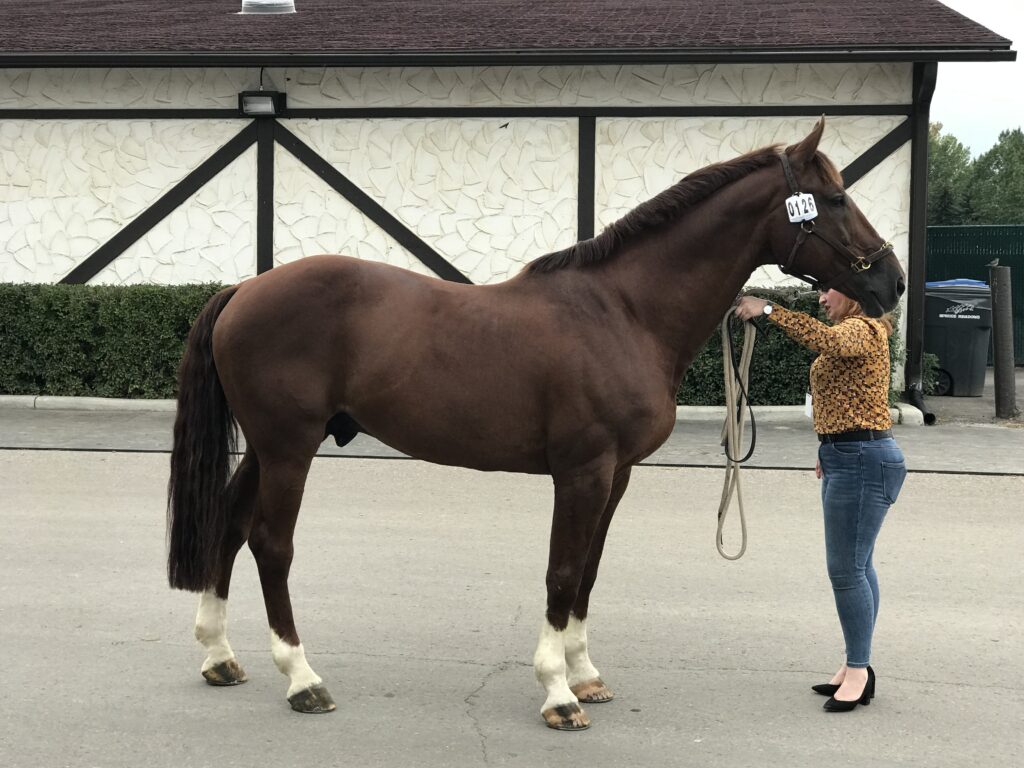
Grama Open Main at 2019 Spruce Meadows Masters
Why Breed to Grama Open Main?
- Structural correctness from the classic German foundation lines
- Scope from the Ibrahim/Almé Z framework, grounded by Voltaire’s rideability
- Maternal integrity from a State Premium-supported bottom line
The Verdict
GOM does not reinvent the wheel. He preserves the one that already works. For breeders who understand that durable athletes are built from proven ingredients rather than current fashion, he offers a thoughtful, high-probability cross.